Small is the right answer here
Most of this trade's advice pushes towards more pages. Therapy is the exception. A person deciding whether to contact a counsellor is not comparing feature lists; they are working up to sending a message. A calm site that answers three or four things and offers one clear next step outperforms a larger one.
So the build is genuinely modest, and the cost reflects that. What costs money is not size. It is getting the privacy right and the tone right.
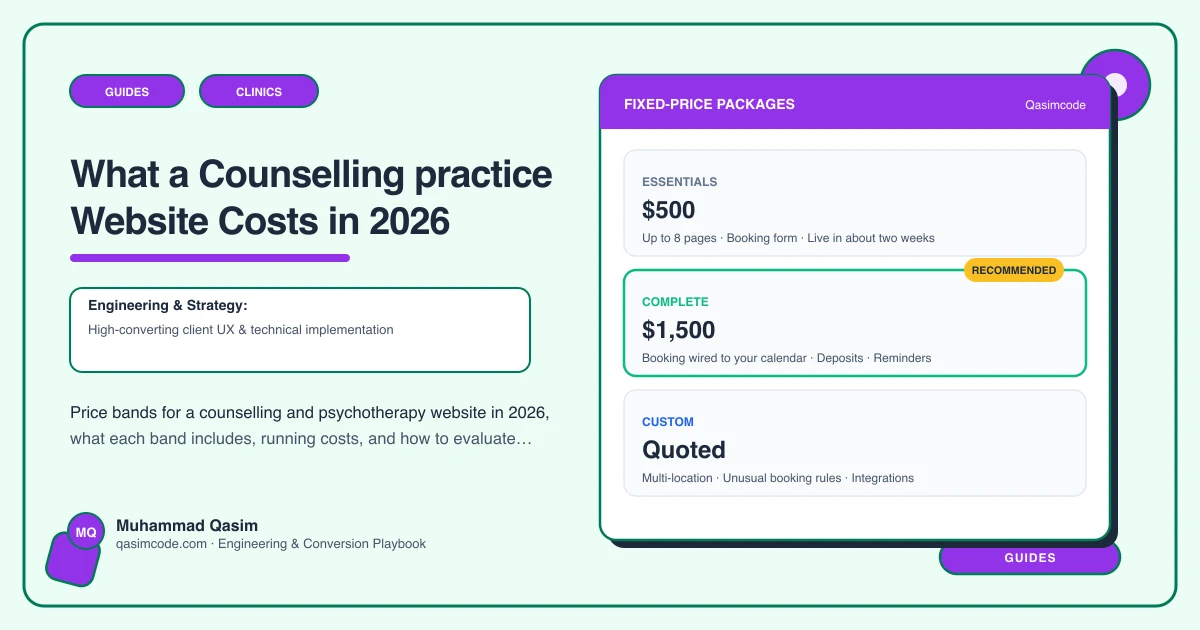
A solo practice: Essentials at $500
Eight pages, live in about a fortnight, two rounds of changes. For a therapist that means:
- A first page with a real photograph, a plain description of who you help, and one next step
- A page per area of work, in the client's words rather than clinical language
- Fees, session length and cancellation policy, stated
- How online sessions work, if you offer them
- Registration and professional body membership, where a client can check it
- A confidential enquiry route and a booking route, side by side
That last point is the one worth spending thought on. Some clients will book a first session directly. Many more want to send a short message before committing to anything. Offering only one of those routes loses whichever group you did not build for.
Fees on the page, not behind a form
Hiding session fees behind "contact me" filters the wrong people. Someone who cannot afford your rate still writes the enquiry, and you both spend time discovering that. Someone who can afford it hesitates because the omission reads as expensive.
Stating the fee, the session length and the cancellation policy costs nothing and does more for your enquiry quality than any other change on this list.
Where privacy is actual work
This is the part of a therapy site that is not cosmetic. Forms collect only what is needed, run through a tool with the right data agreement for the country you practise in, and nothing is stored on the website itself. In the United States that means a HIPAA-capable tool rather than a generic form.
Getting that right takes setup time. Getting it wrong is the kind of thing that is expensive to discover later. Your privacy policy should describe what actually happens, which means the policy is written after the plumbing, not before it.
On testimonials: most professional bodies discourage or prohibit them for therapy, and Australian regulated health services cannot use them at all. We do not use them. Qualifications and a clear description of your approach do that job instead.
A group practice: Complete at $1,500
Twenty pages, about four weeks, four rounds. Worth it once several therapists share the practice, because each needs a profile, their own areas of work, their own fee where it differs, and a booking route that reaches them specifically.
An existing site
Diagnosis is $299 with a report in three days: what is broken, the cost of each fix, and a straight fix-or-rebuild answer. Diagnosis and fix is $799 over roughly two weeks.
Monthly, afterwards
- Domain, renewed yearly and registered to you
- Practice software, paid direct to Jane, Cliniko, Zanda, SimplePractice, Power Diary or WriteUpp
- Hosting
- Optionally a care plan: Basic $99/mo, Growth $249/mo including four hours of changes
Where this sits
We build counselling and psychotherapy websites with both contact routes and privacy done properly, at a fixed price. The wider clinic view is on the clinics page.