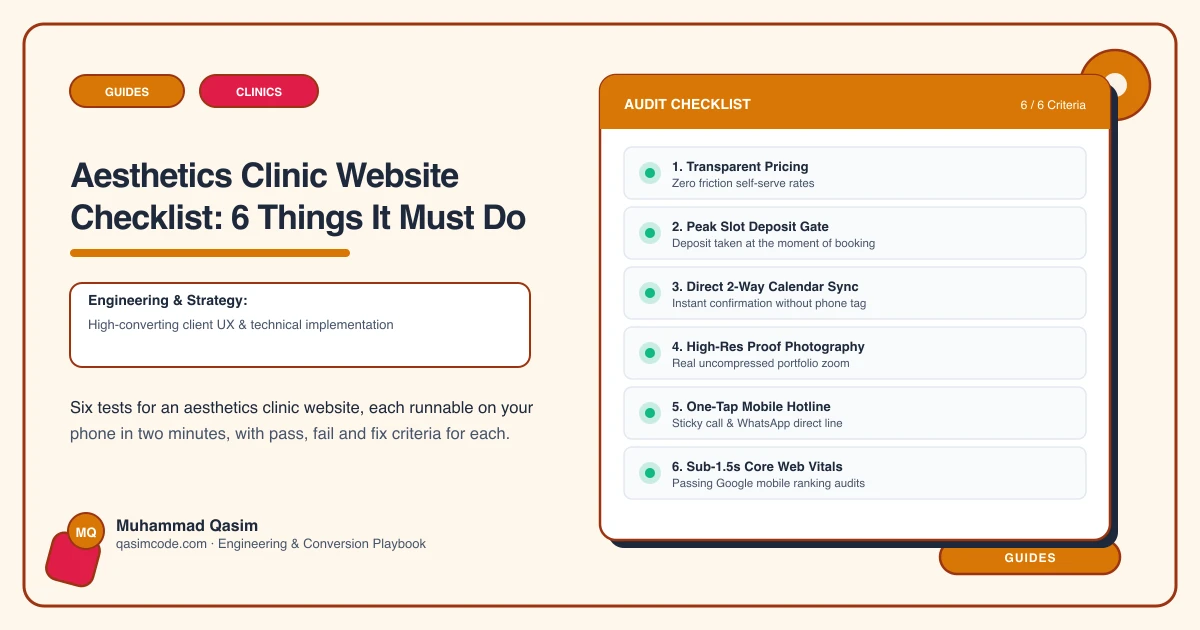
Six tests, ten minutes
An aesthetics clinic has the hardest advertising position on this list: the treatments people search for are frequently the ones you are not allowed to advertise by name. Run these on a phone.
1. Write treatment pages that stay legal
The test: read your anti-wrinkle page as if you were an advertising regulator.
Pass: each treatment page written to your country's rules — which in several markets means not naming a prescription-only medicine at all, and describing the consultation rather than the product.
Fail: the brand name of a prescription injectable used as a page title or a price-list item. This is the most commonly enforced rule in the sector and the penalty lands on you, not your supplier.
The fix: write to the consultation and the outcome. Name the treatment category, not the prescription product, and keep the page factual.
2. Take a deposit at consultation booking
The test: book a consultation.
Pass: live availability, a card deposit taken, and consent forms sent in advance.
Fail: a free consultation booked with a name and an email, which is why aesthetics clinics have the worst no-show rates of any trade on this site.
The fix: Pabau, Fresha, Zenoti, Boulevard, Phorest and Timely all take deposits at booking. A deposit is the single highest-return change available to an aesthetics clinic.
3. Show prices you can stand behind
The test: find the cost of your most-asked-about treatment.
Pass: from-prices, courses and memberships, editable without a developer.
Fail: "prices from consultation only", which sends a price-comparing client to whoever published a number.
The fix: publish from-prices with what changes the number. You are not committing to a quote; you are staying in the shortlist.
4. Handle before-and-after imagery correctly
The test: check every gallery image for consent, and check whether your market permits them at all.
Pass: consent recorded per case, factual captions, and the gallery switched off entirely where it is prohibited.
Fail: supplier-provided stock results, or real patient photographs without documented consent.
The fix: consent per case, held on file. Where your market bans before-and-after imagery for a treatment class, remove it rather than risk it — the pages still convert on the consultation.
5. Show who is qualified to inject
The test: find who performs the treatments and what they are registered as.
Pass: practitioner profiles with clinical registration, prescribing arrangements where relevant, and what each one does.
Fail: first names and glamour photography. Clients are increasingly aware that qualifications vary enormously in this sector, and the ones who check are the ones who spend.
The fix: state registrations plainly and link the register. It is a competitive advantage precisely because so many clinics are vague about it.
6. Load in under two seconds
The test: on mobile data, count until the booking button is usable.
Pass: under two seconds.
Fail: a full-screen video, a carousel of results, and a chat widget — the three things aesthetics sites almost always have.
The fix: one compressed image, no carousel, booking script on tap. Visual polish is worth less than a page that appears before the client's attention moves on.
Scoring
Six passes and the site is compliant and converting. Four or five, fix in order. Three or fewer and start with the treatment-page wording and the consultation deposit — one protects you, the other pays for the rebuild.
Where this sits
Our aesthetics clinic websites are built to pass all six at a fixed price. The wider clinic version is on the clinics page. Advertising rules for prescription treatments differ sharply by country, which the country pages cover.