Two things drive this budget, and neither is design
An aesthetics website has an unusual pair of constraints. Consultations get booked and not attended, so the site has to take a deposit. And what you may say about treatments is regulated differently in every country, so the copy has to be written to a standard before it is written to a style.
Everything else is ordinary web work. Those two are where the money and the care go.
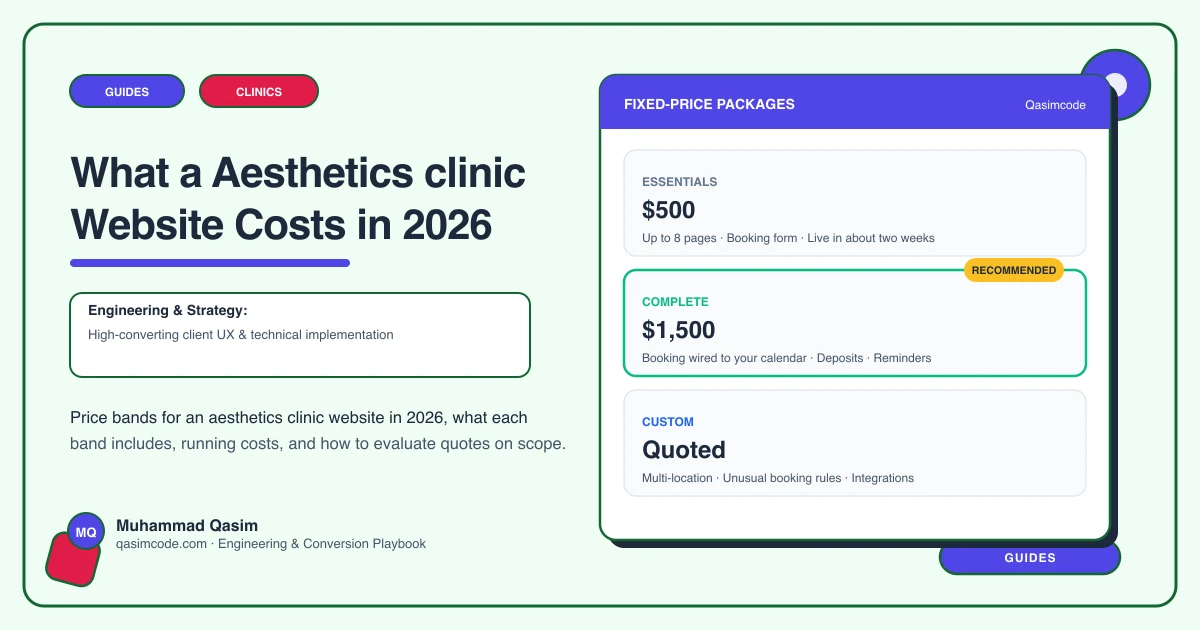
The recommended build: Complete at $1,500
Twenty pages, about four weeks, four rounds of changes. For an aesthetics clinic the room goes on:
- Consultation booking that takes a card deposit, redeemable against treatment, with consent forms sent ahead
- A page per treatment, written to your country's advertising standards
- From-prices, courses and memberships you can edit without a developer
- A before-and-after gallery with consent recorded per case and factual captions
- Practitioner profiles carrying prescriber status, registration and training
- A fast, calm build: no autoplaying video, under two seconds on a phone
The deposit is the highest-return decision
A consultation slot is a practitioner's hour. Booked and not attended, it is gone. A card deposit taken at the moment of booking, credited against the treatment if they attend, changes the behaviour of the booking rather than punishing anyone.
Every booking tool listed below can do this. Most clinics simply have not turned it on, or have turned it on for treatments and not for the consultation, which is where the no-shows actually are.
Where the advertising rules sit
This is the part that is genuinely different from other clinic work, and it varies by country. In the UK, prescription-only medicines cannot be advertised to the public by brand name, so the page describes anti-wrinkle injections and the brand is discussed in consultation. Elsewhere the rules differ again.
Photography carries its own constraint. A before-and-after gallery needs written consent per case and factual captions, and Australia restricts them for regulated health services under AHPRA. That means the gallery has to be built so it can be switched off by region rather than hard-coded.
Writing to those limits from the start costs nothing extra. Rewriting after a complaint costs real money, and the pages are down while it happens.
Where Essentials at $500 works
A single practitioner with a short treatment list, no gallery, and prices given at consultation can start on eight pages in about a fortnight. You keep deposit-taking consultation booking, which is the part that pays for itself. You lose the room for a page per treatment, which is where the search traffic lives.
An existing site
Diagnosis is $299, reported in three days: what is broken, what each fix costs, and a straight answer on fixing versus rebuilding. Diagnosis and fix is $799 across about two weeks.
Monthly, after launch
- Domain, renewed yearly in your own name
- Booking software, paid direct to Pabau, Fresha, Zenoti, Boulevard, Phorest, Timely or Cliniko
- Hosting
- A care plan if price lists, new treatments and consent records should be maintained for you: Basic $99/mo, Growth $249/mo with four hours of changes
What changes the quote
- How many treatments get their own page
- Whether the gallery is built, and for which regions it is enabled
- Whether packages and memberships need their own pricing logic
- How many practitioners need a profile with prescriber status
- Which country's advertising standards the copy is written to
Where this sits
We build med spa and aesthetics websites with deposit-taking consultations and compliant treatment pages at a fixed price. The wider clinic view is on the clinics page.