The number depends on one question
Every OT practice that asks what a website costs is really asking something narrower: does the site only need to explain the work and book assessments, or does it also need a route for the schools, insurers and solicitors who commission reports? That distinction moves the price more than page count or design does, because a referrals arm is a second audience with its own pages, its own form and its own fee structure.
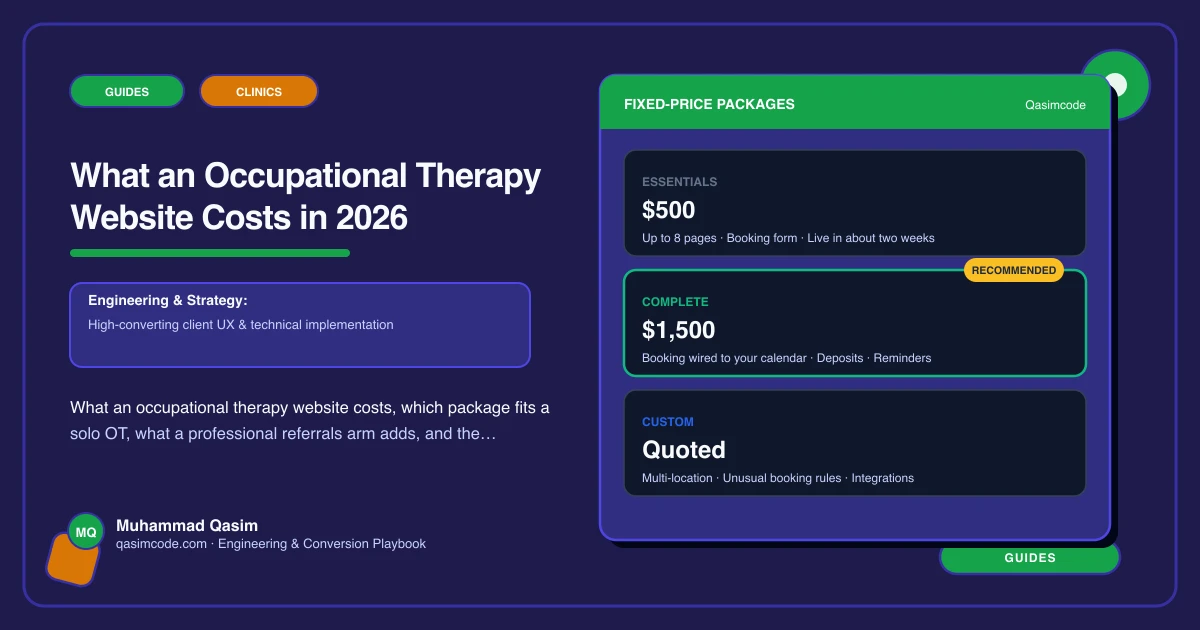
A solo practice explaining the work: Essentials, $500
For a therapist working alone, Essentials covers it. Up to eight pages, live in about two weeks, two rounds of changes. Eight pages is enough for the structure an OT site actually needs:
- A first screen written in outcomes rather than the name of the profession
- A page for each group you work with, up to about three
- An assessment page that walks through the visit and the report
- Fees
- A profile carrying your registration
- Contact
That is the whole job for a practice whose enquiries come from families. It is also the version most solo OTs should buy, because the alternative is paying for a referrals arm before there are any referrers.
A practice with a referrals arm: Complete, $1,500
Complete is up to twenty pages, live in about four weeks, four rounds of changes, and it is where booking is wired into your calendar rather than landing in an inbox. For an OT practice the extra pages go somewhere specific:
- A page per group in full, rather than the best three
- Separate family and professional-referrer sections, each with its own form
- An assessments and reports page with turnaround times and a fee per report type
- Home-visit and school-visit pages naming the areas you cover
- A profile per therapist, each with registration
- Price lists you can edit yourself
Booking: included, or quoted separately
With a new Complete site, booking setup is part of it: the system chosen for how you work, connected to your Google or Outlook calendar, deposits through Stripe, automatic reminders, and confirmation emails checked so they actually reach the inbox. Adding booking to a site you already have is quoted in a day and usually takes a week.
Your practice software is a separate line you pay directly. Cliniko, Jane, Zanda, Power Diary and WriteUpp all handle assessment and therapy appointment types at different durations, home-visit bookings where you do them, and intake forms sent before the first visit.
An existing site that is not working
If a site already exists, the honest first step is finding out whether it is worth keeping. A Diagnosis is $299 with a report in three days: what is broken in plain English, what each fix costs, and whether to fix or rebuild. Diagnosis and fix is $799 and usually two weeks. A rebuild is quoted after the diagnosis, never before it.
What it costs after launch
- Your domain, renewed annually in your own name
- Your practice software subscription, paid direct to Cliniko, Jane, Zanda, Power Diary or WriteUpp
- Hosting
- A care plan, if you want updates, backups and fixes to be somebody's job: Basic at $99/mo, Growth at $249/mo with four hours of changes included, Scale at $499/mo
What actually moves the quote
For an OT practice, five things do:
- How many groups you work with, since each one is a page and a separate search
- Whether reports for third parties are part of the practice at all
- Whether you do home and school visits, and across how many areas
- How many therapists need a profile
- Whether fees are one assessment price or a table per report type
Design complexity is not on that list, and a quote that prices it heavily is pricing the wrong thing.
Where this sits
Our occupational therapy websites are built to that structure at a fixed price. If the site you have now is the problem rather than the plan, start with why your OT site gets no bookings, or run the six phone tests on it first.