The number turns on the dispense, not the design
Two questions set the price of an optometry practice website, and neither is about how it looks. Does the site only need to be found and rung? Or does it need to book a typed eye test, say who gets a funded one, and give a patient a reason to buy the glasses in the practice rather than from a retailer that posts a try-on box? The second job is where the pages and the money go.
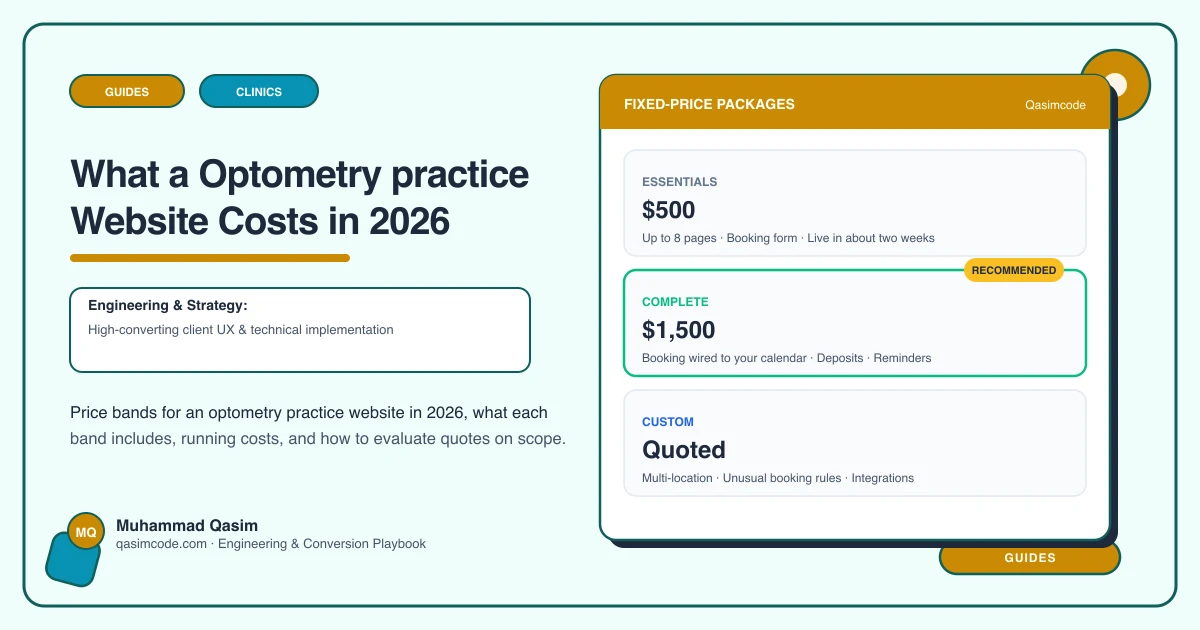
Why an optometry site lands on Complete, $1,500
Booking, funded-test information, frames and lens pages and a reorder route for contact lens wearers take a practice past Essentials. Complete is $1,500, live in about four weeks: up to twenty pages, four rounds of changes, and booking wired into the calendar you already keep instead of dropped into an inbox. In optometry those twenty pages go somewhere particular.
- A booking page carrying every test type you run, each at its own length
- A page on the funded test in your country, and which type to book for it
- A page per frame brand, or per group of brands, inside their own guidelines
- A lens page covering thinning, coatings and fitting in the words a patient uses
- A contact lens page, plus a reorder route for people already wearing them
- A profile per optometrist, each carrying registration
- Hours, directions and parking for every branch
Where Essentials still fits, $500
Essentials is $500 and about two weeks, up to eight pages. It is the honest buy for a single-handed practice whose dispensing happens across the counter and whose patients already know the name: hours, location, the test types, one booking link, one page about the optometrist. It stops fitting the day you want the frames doing any of the selling, because a brands page nobody can edit is worse than no brands page.
Booking, and the bill underneath it
With a new Complete site, booking setup is inside the price: the system chosen for how your chairs actually fill, connected to Google or Outlook, deposits through Stripe, reminders going out, and the confirmation email tested so it clears junk. Adding booking to a site you already own is quoted in a day and usually takes a week. Either way the practice software subscription stays yours and is paid direct — no build absorbs it.
If there is already a site
Anyone quoting a rebuild before looking is guessing. A Diagnosis is $299, report in three days: what is wrong in plain English, a cost against each fix, and a straight answer on whether it is worth keeping. Diagnosis and fix is $799 and about two weeks. A rebuild gets quoted after that, not before.
Five things that actually move the number
- How many test types are bookable. A standard sight test, a contact lens check and a children's test are three durations, and usually three pages and three searches.
- How many frame brands get a page. Six ranges is six sets of copy and imagery to clear against brand guidelines. One overview page is an afternoon.
- Whether lens reordering goes online. A reorder form is small. A logged-in area for existing wearers is a different build, and it lives in Custom.
- How many optometrists need a profile. Each is a page, a photograph and a registration number somebody has to keep current.
- How many branches. Every extra address is its own hours, directions and local result to earn.
The funded-test page is not on that list. It is one page and it barely registers on a quote, which makes it the strangest thing to be missing as often as it is.
What it costs once it is live
The domain renews annually in your own name. Hosting is small. The practice software is its own line. The cost people forget is editing: ranges change, an optometrist joins, a branch moves its late night. A care plan makes that somebody's job — Basic $99/mo, Growth $249/mo with four hours of changes in it, Scale $499/mo.
Where this sits
Our optometry practice websites are built to that shape at a fixed price. To judge what you have now, run the six phone tests for an optician site, or read why an optometry site gets no bookings.