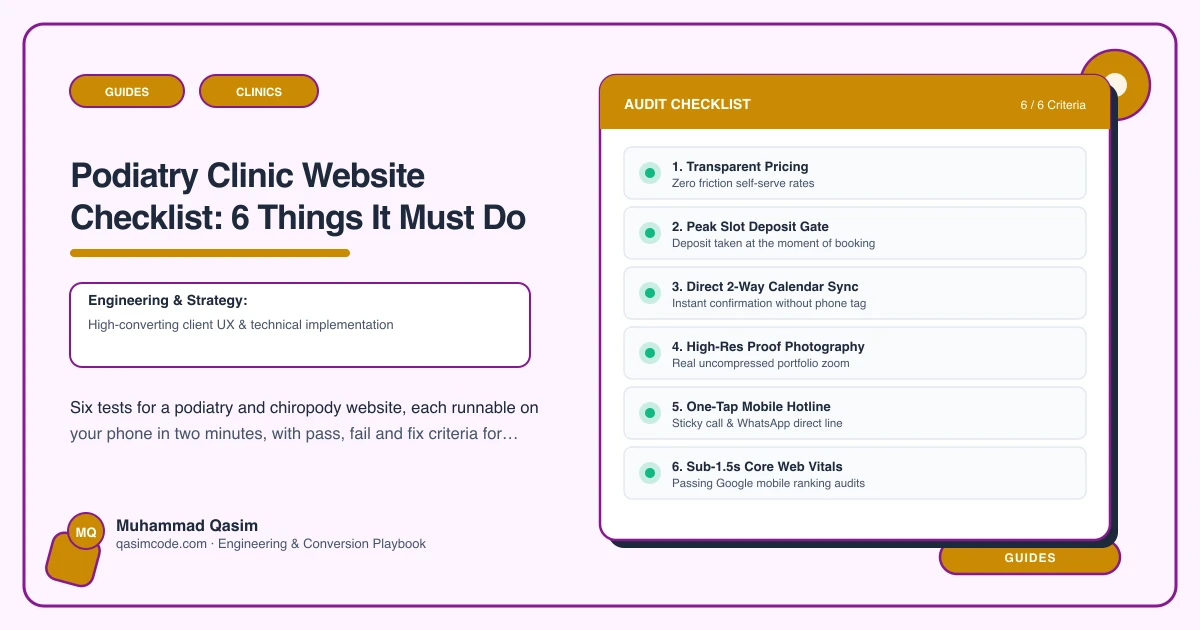
Six tests, ten minutes
Run these on a phone, on mobile data, as a patient with a painful foot who wants it seen this week. Score each pass or fail and fix in the order the failures come.
1. Find the page for the problem you have
The test: search your own site for "ingrown toenail" and then "heel pain".
Pass: a page for each condition you treat, in the words patients use, with what you do, what it costs and a booking button.
Fail: a services list with six words per item, or one "conditions" page covering everything.
The fix: write the six conditions you see most. Patients search the problem, never the profession, and a page per condition is a page per search.
2. Book the right length of appointment
The test: book nail surgery, then book a routine review.
Pass: different appointment types with different durations, and pre-appointment information sent automatically for the procedure.
Fail: one generic appointment length, which means either the procedure is rushed or the diary is wrong for the rest of the day.
The fix: typed appointments in Cliniko, Jane, Zanda, Power Diary or Nookal.
3. Find out whether you visit at home
The test: as the relative of a housebound patient, work out whether you would come to them.
Pass: a home-visit page with areas covered, what is included, the price, and a request form.
Fail: nothing, or a sentence on an about page.
The fix: build the page. Home visits are frequently the most profitable line a podiatry clinic has and the least advertised.
4. Understand what a podiatrist is
The test: as a patient who has only heard the word "chiropodist", find out whether you are in the right place.
Pass: a plain line on what a podiatrist treats and how the titles relate, plus registration numbers on every profile.
Fail: the assumption that patients know. Many do not, and they leave to check.
The fix: one sentence and a registration number. It costs nothing and it stops the bounce.
5. Book diabetic foot care as its own service
The test: look for it, as the son or daughter of a diabetic patient.
Pass: its own page, written for both patient and relative, covering what a review involves and how often it is needed.
Fail: a bullet inside a services list.
The fix: one page. It is recurring clinical work and the searcher is frequently a family member acting on someone's behalf.
6. Appear in under two seconds
The test: on mobile data, count until the booking button is usable.
Pass: under two seconds.
Fail: a slider of clinical photography, a chat widget, or a booking script loading on every page.
The fix: one compressed image, chat off, booking script on tap.
Scoring
Six passes and the site is working; spend on advertising instead. Four or five, fix the failures in order. Three or fewer and the missing condition pages are almost certainly the problem — they are how new patients find a podiatry clinic at all.
Where this sits
Our podiatry clinic websites are built to pass all six at a fixed price. The diagnostic version is why your podiatry website gets no bookings. The wider clinic view is on the clinics page.