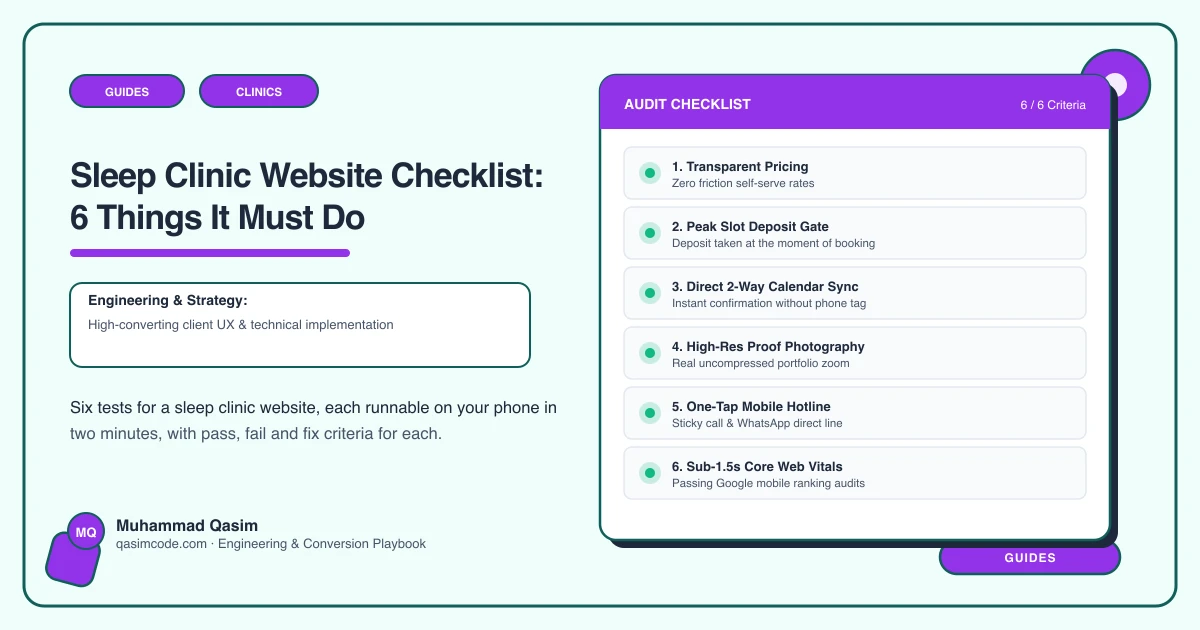
Six tests, one phone, ten minutes
Come off the clinic Wi-Fi onto mobile data, open a private window, and find your own site the way a patient who cannot sleep finds it at one in the morning. Each test is something you physically do, not something you judge. Note which ones fail.
1. Take a consultation slot, then try to take a study
The test: on the phone in your hand, book an initial consultation for next week. Go back and try to book a study.
Pass: live availability appears, the two are separate appointment types with their own lengths, and an intake questionnaire reaches your inbox straight away.
Fail: one general enquiry form for both, or a single slot type covering both.
The fix: embed availability from whichever system you run — Semble, Cliniko, Jane or Zanda — with consultation and study as separate appointment types and the questionnaire going out ahead.
2. Read the study page to somebody outside healthcare
The test: hand the page to a friend who has never had a study, then ask what happens to the equipment overnight and when they would get a result.
Pass: they answer both, and can say whether they would be sleeping at home or staying with you.
Fail: they ask you the questions the page existed to answer.
The fix: one page covering both routes in order — home and in-clinic, the equipment, the night, the results, what follows. Short sentences: these readers are not sleeping.
3. Search your own domain for one condition
The test: in Google, run site:yourdomain.com snoring. Repeat it for insomnia, for narcolepsy, for restless legs.
Pass: each condition you treat returns a page of its own, titled in the words a patient would type, with booking on it.
Fail: every search lands on the same services page, where the condition is one line in a list.
The fix: a page per condition. Five written up separately is five ways to be found; one page mentioning five is one.
4. Price the equipment as a newly diagnosed patient
The test: using nothing but the site, work out what equipment costs to get and what it costs to keep.
Pass: the options are laid out, fitting described, the ongoing cost of consumables stated, follow-up explained.
Fail: CPAP appears as something you offer, with no figure attached anywhere.
The fix: an equipment page carrying both numbers, up front and ongoing. A clinic that publishes them wins against one that makes people ring to ask.
5. Answer the referral question against a clock
The test: time yourself finding what a study costs, and whether a referral is needed to have one.
Pass: consultation, study and equipment fees on a page reachable from the menu, and the referral answer given per route, not in general.
Fail: fees on request, or a referral requirement the site never mentions.
The fix: publish a fee for each thing people ask about, and the referral position for every route you accept. Requirements differ by country and by insurer, so answer for the routes you take and let the booking collect the paperwork.
6. Tap a specialist's name
The test: from the home page, tap the name of whoever would see this patient.
Pass: a page for that person with qualifications, registration and what they concentrate on.
Fail: a group photograph, first names only, or a team strip that links nowhere.
The fix: a profile each. Registration is a requirement in this field, and a patient checking will look here first.
Scoring
Which failed matters more than how many. Test 1 costs money tonight: a patient who cannot book rings somebody who lets them. Tests 2 and 4 decide whether a person who has postponed this for years stops. Test 3 decides whether they find you at all. Tests 5 and 6 lose the enquiries you never hear about, from people who assumed the answer was expensive or could not tell who they would see. Fix in that order, on a phone rather than a desk monitor.
Where this sits
Our sleep clinic websites are built to pass all six at a fixed price. For the same ground ordered by cost, read why a sleep clinic site gets no bookings or what a sleep clinic website costs.