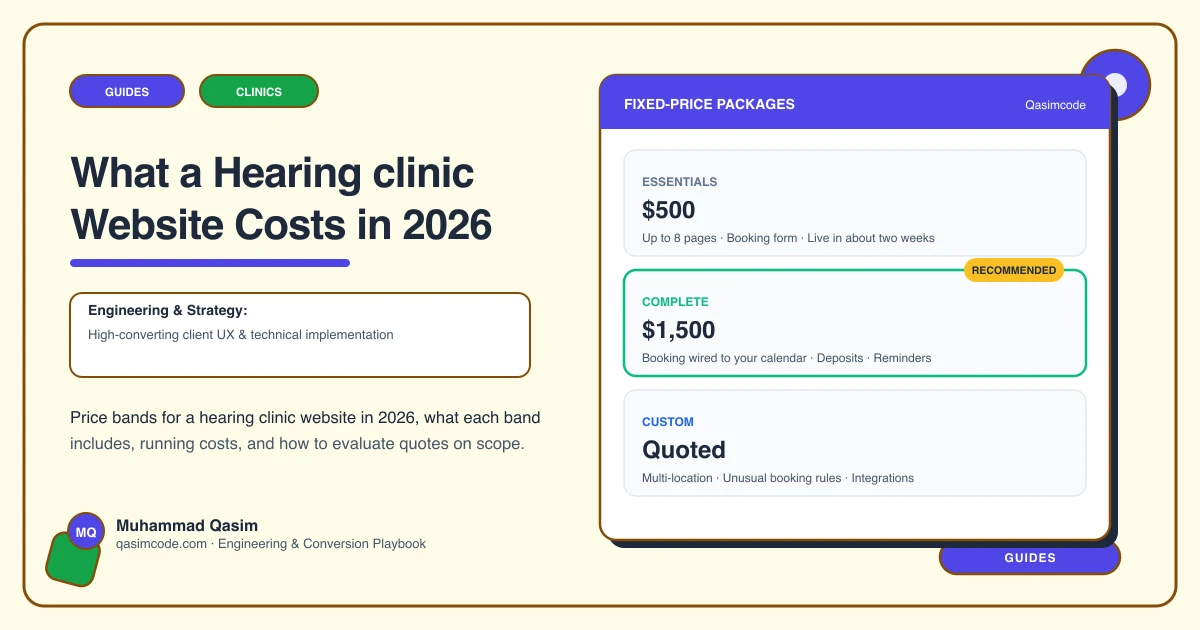
The number comes down to page count
A hearing clinic is almost never a one-service website. The hearing test wants a page that says what happens and how long it takes. Hearing aids want pages by technology level, because a number with nothing attached to it is not a price. Wax removal wants a page of its own, since people search for it on its own. Funding wants a plain explanation of who qualifies. Each audiologist wants a profile carrying registration. Add booking and a contact page and the site is past eight pages before anybody has opened a design conversation.
That count is what sets the price of an audiology build. Styling barely touches it.
One audiologist working alone: Essentials, $500
Essentials is up to eight pages, live in about two weeks, two rounds of changes. For a single-audiologist clinic that is genuinely enough, provided the eight pages are spent deliberately:
- A first screen the patient can read and a son or daughter can act on
- The hearing test, with what it involves and what it costs
- One hearing aid page carrying ranges, rather than a page per level
- Wax removal, with the price and the method
- Your profile, with qualifications and registration
- Contact, with the phone number and hours next to the form
The full page set: Complete, $1,500
Complete is up to twenty pages, live in about four weeks, four rounds of changes, and booking wired into the diary you already keep instead of landing in an inbox. In a hearing clinic the extra pages have obvious homes:
- A page per technology level, each stating the fitting, the follow-ups and the warranty
- A funding page for the scheme where you practise: who qualifies, and how to book that appointment
- Wax removal as a service in its own right rather than a bullet
- One profile per audiologist
- Price ranges in a table you can edit yourself when the range changes
- Every page checked with system text scaled up, because a real share of your patients read that way
Where booking sits in the price
On a new Complete site, booking setup is inside the $1,500: the system chosen around how your clinic actually runs, connected to your calendar, reminders switched on, and the confirmation email tested so it lands in the inbox rather than the junk folder. Bolting booking onto a site you already have is quoted in a day.
Your clinic software subscription is billed separately by whoever supplies it. You carry that line with or without a new website.
If a site already exists
Do not commission a rebuild before anybody has looked. A Diagnosis is $299, with the report in three days: what is actually wrong in plain language, what each repair would cost, and whether repairing beats starting again. Diagnosis and fix is $799 and usually about two weeks. Any rebuild is quoted after that report rather than in place of it.
The monthly side
- The domain, renewed in the clinic's own name
- Hosting
- Your clinic software, paid direct to the vendor
- A care plan, when updates, backups and small edits should be someone else's problem: Basic $99/mo, Growth $249/mo with four hours of changes, Scale $499/mo
Five things that move it
For a hearing clinic, these are the five that genuinely change the quote:
- How many technology levels you price, since each needs its own inclusions written out
- Whether wax removal is on your list, because it earns a page and a booking route of its own
- How many funding routes apply where you practise, as each one needs its own eligibility page
- How many audiologists need a profile with registration on it
- Whether you want to edit the price ranges yourself or send them over for us to change
What does not move it: the readability work. Large type, real contrast, generous tap targets, checked at scaled text sizes. That is in every build we do here, because in this field it is not an upgrade.
Where this sits
We build hearing clinic websites to that page set at a fixed price. To choose the diary the booking hangs off, read booking systems for a hearing clinic website. To audit the site you have before spending anything, run the six phone tests.