Six things, six tests, your own handset
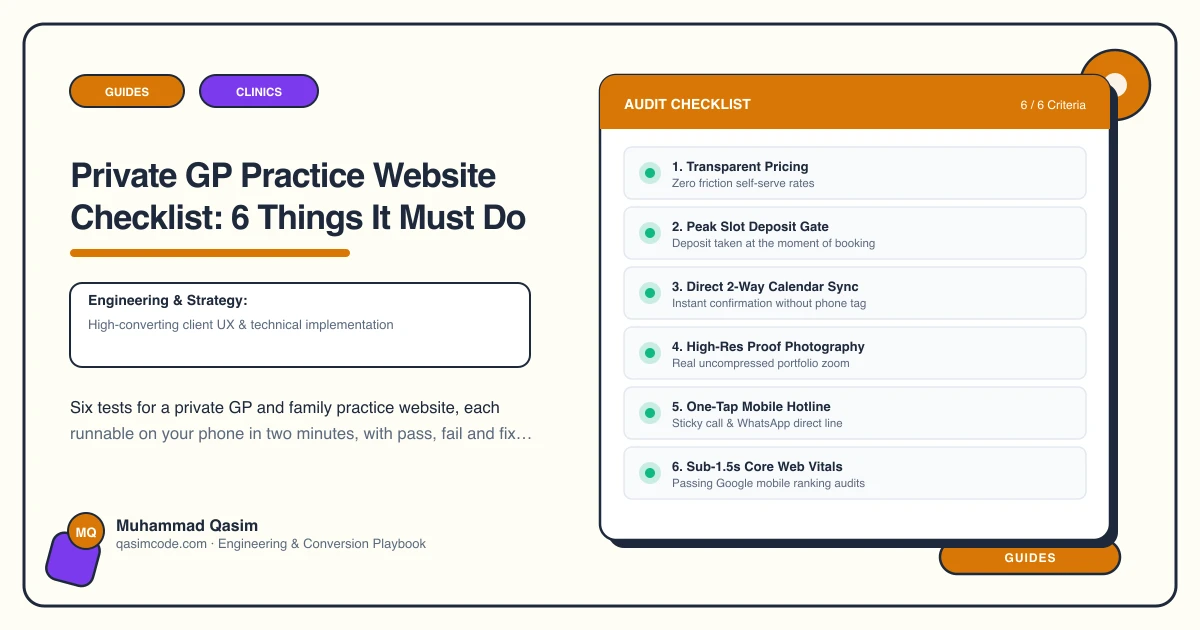
Six things belong on a private GP practice website. Here is each one as something you can physically do on a phone in the next ten minutes. Come off the practice Wi-Fi onto mobile data, open your site in a private window, and behave like a patient who needs seeing today.
1. Same-day and video booking
The test: try to book an appointment for today. Then go back and try to book a video consultation for today.
Pass: a real time appears for both, taken from live availability in Semble, Meddbase, Cliniko, Jane or Zanda, and you can confirm it without speaking to anyone.
Fail: a form that promises a call back, a phone number as the only route, or in-person slots showing while video is invisible.
The fix: embed live availability from whichever of those five you already run, with in-person, video and phone set up as separate appointment types.
2. Fees stated by type
The test: find what a short consultation costs, then what a longer one costs, then what a letter or certificate costs.
Pass: all three are on a page you reached from the menu, with remote appointments priced too.
Fail: "fees on request", a single figure covering everything, or a price that only appears after you submit your details.
The fix: a fee page organised by consultation length and type, with the common extras — tests, letters, certificates — listed underneath.
3. Prescriptions, referrals and tests explained
The test: pick one of the three and find its page. Can you learn what happens next, in the words a patient would use?
Pass: a page each, saying what the practice does, roughly how long it takes and what it costs.
Fail: one bullet inside a Services page, or the information living only in reception's head.
The fix: three pages, written in patient language. Each answers a question reception fields daily, and each is a search somebody is already making.
4. GP profiles with registration
The test: tap a doctor's name from anywhere on the site.
Pass: their own page, with qualifications, a registration number and the areas they take a particular interest in.
Fail: a name and a photograph on a shared About page, or a photograph with no name.
The fix: a page per GP. Private patients are choosing a person and paying to do it, and the registration number is the single most reassuring thing you can put on a website.
5. Regulatory details displayed
The test: scroll to the very bottom on your phone and read the small print.
Pass: practice registration and company details are there, in the form your country requires, and legible at phone size.
Fail: nothing but a copyright line, or details in an image that cannot be read or selected.
The fix: put them in the footer as real text. What has to appear differs by market — the country pages cover which requirements apply where you practise.
6. Patient data handled properly
The test: open your new-patient or enquiry form and read what it asks for. Then find out from whoever built the site where those answers are stored.
Pass: the form belongs to the practice software or booking tool that has the correct agreement for your country, and the website keeps no copy.
Fail: a generic contact form emailing health information around, or a plugin quietly saving submissions into the website's own database.
The fix: move intake into the tool that holds the agreement and delete the stored submissions. A GP practice handles the most sensitive data of any clinic type, and the website should hold none of it.
Scoring
Which tests failed matters more than how many. Test 1 is the one the patient came for, so a failure there costs a booking every time it happens. Test 2 decides whether someone already convinced will act or keep comparing. Tests 3 and 4 are why a private fee feels reasonable rather than steep. Tests 5 and 6 cost nothing to fail until the day they cost a great deal.
Where this sits
Our private GP practice websites are built to pass all six at a fixed price. For the same list ordered by what each failure costs you, read why a private GP site gets no bookings. For what the build itself comes to, see what a private GP website costs.