The short answer
Where you can, yes. Fixed fees, hourly ranges, or an honest description of how you quote. Fee transparency is increasingly expected by regulators and always valued by clients, and the practices that resist it are usually protecting against a risk that turns out to be smaller than the one they are running by staying silent.
That said, the objections are real and worth answering one at a time.
"Competitors will undercut us"
They already know. Any competitor who wants your fee level rings and asks, or asks a client, or reads the same market you read. The people your silence keeps out are not competitors, they are clients.
There is a stronger version of the worry: that publishing invites comparison on price alone. That is true of a bare number on a bare page. It is not true of a fee published beside what is included, who does the work, how long it takes and what happens if the scope changes. Context is the defence, not secrecy.
"Every matter is different"
Most of them are not, and the ones that are can be described. Practices usually have a spine of standard work, a will, a set of accounts, a tax return, a lease review, a certified translation, a document notarised, a mortgage application, that prices perfectly well. Publish those, then describe the quoting process for the rest.
"We charge £280 an hour for partner time and £190 for associate time. A typical boundary dispute that settles before proceedings runs to eight to fifteen hours. We give a written estimate after the first meeting and tell you before we exceed it." Nothing there is a false promise, and it answers the question.
"We would rather have the conversation"
You would. The client would rather not have to ring to find out whether you are in their range. The conversation still happens; publishing a range simply means it happens with people who have not already ruled you out.
Look at it from the enquiry side. A phone call to ask about price is a call your team has to take, from a person who may be nowhere near your market. A published range means the calls you take are from people who have seen the number and rung anyway.
"Our regulator restricts what we can say"
Regulators restrict how charges are presented, not whether you may state them. Several regimes have moved in the opposite direction, towards requiring publication for particular work types, and general consumer law everywhere requires that any published price be accurate and complete about what it excludes. In the United States, state bar advertising rules and the marketing rules for advisers and broker dealers set expectations about how fees and any comparison may be described rather than banning the subject.
The safe pattern is the same in every jurisdiction: state the charge accurately, state what it excludes, say whether tax is included, avoid implying a total that is not one, and have your compliance lead read the page. Treat this as orientation rather than legal advice and check your own body's current guidance.
What to publish when a number is impossible
Four things, and they satisfy most visitors:
- How you charge. Fixed fee, hourly, percentage, retainer, commission, or a combination, per service.
- What moves the price. The two or three factors that decide where in the range a matter lands.
- What is not in the fee. Disbursements, third party costs, taxes, court and registry fees.
- How to find out for certain. What you need from the client, how long a quote takes, whether the first conversation is free and whether the quote is fixed once given.
That is a real answer. "Contact us for a quote" is not.
The disclosures that come with it
Some professions have a specific version of the money question that matters more than the fee itself. A mortgage broker's clients want to know how the broker is paid: fee, commission, both, and whether the fee is refunded on completion. An insurance broker's clients want the same. A financial adviser's clients want the initial and ongoing charge with a worked illustration in money, not only a percentage. Those belong on the page in their own right, which is why the mortgage brokers build treats how you are paid as a headline section.
Where the numbers live
Not typed into a page. In a fee field on each service record, with a note field for inclusions and exclusions. The Fees page renders the table, each service page renders its own line, and both change when the practice manager edits one field. Add an effective date, and a reminder to review it annually, so the page is either right or visibly dated.
The test
Ask whoever answers the phone how many callers open with a question about price. If it is most of them, the site is failing at the first hurdle and every one of those calls is unpaid work. Publishing does not end the conversation, it starts it with a better informed person.
Where this sits
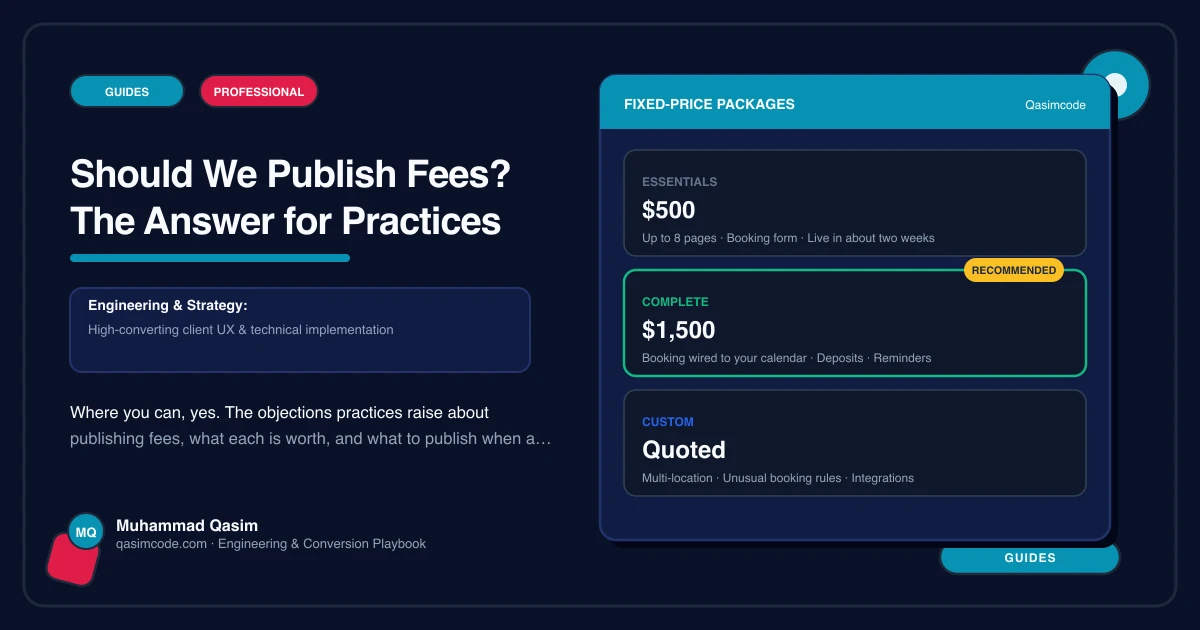
Fees stated plainly, or the quoting process explained, is one of the things every professional services website has to do before launch, and the shape differs by profession across the sub pages, from accountants with monthly packages to notaries with a table by document type. We publish our own build prices on the pricing page for exactly the reason we recommend it.